
Discover AES Rackmount 48-5120
October 21, 2026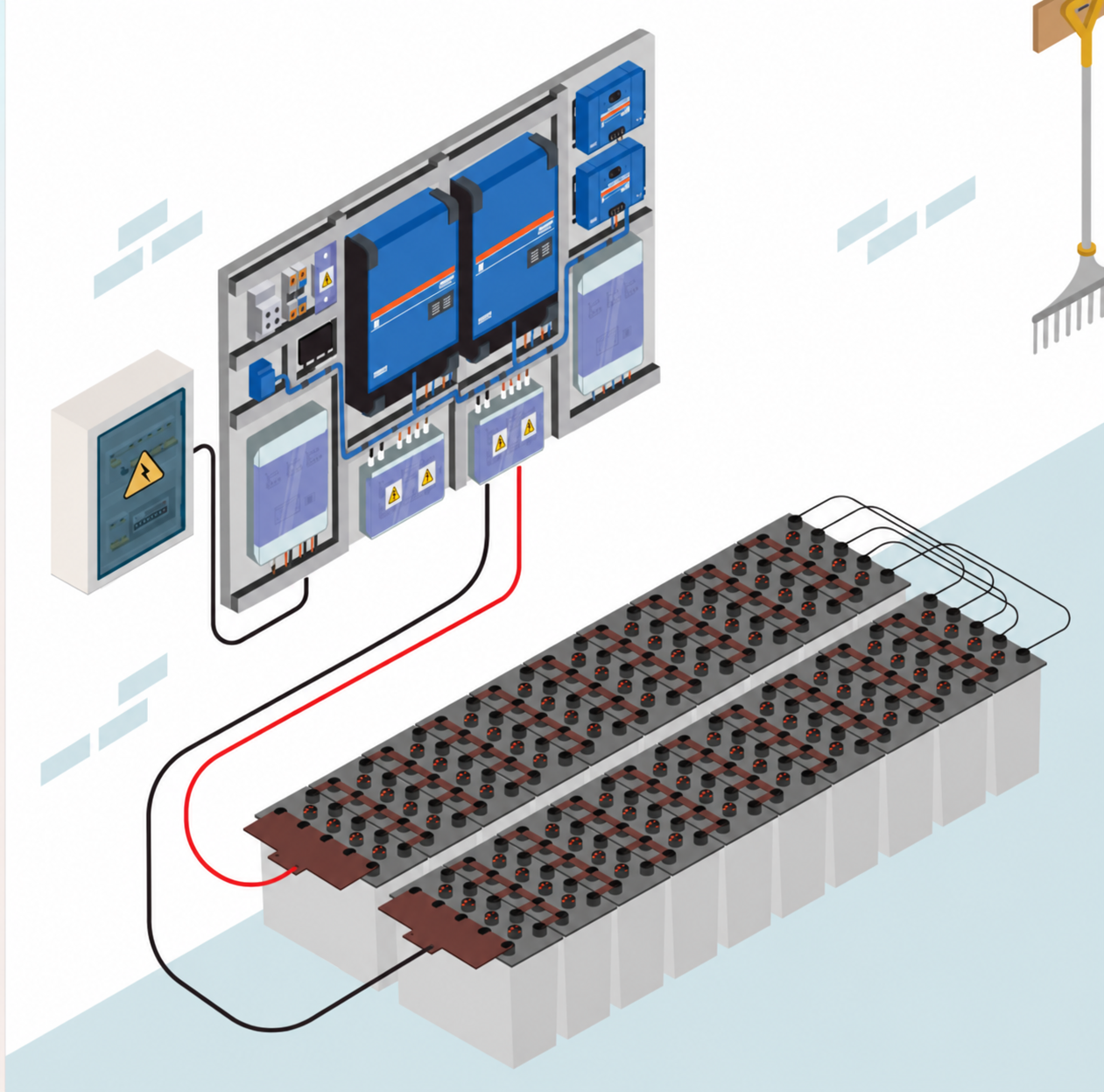
48V Victron off-grid pre-wired split-phase (240V)
Pre-wired off-grid board · 120/240 V split-phase
18 kW peak
2 × MultiPlus-II 48/5000/70-95 120 V
SmartSolar MPPT 250/100-Tr VE.Can
also lithium and lead-acid, 48 V
PowerAssist · auto start/stop · 240 V generator
DC/AC breakers, SPD type 2, disconnects
free VRM remote monitoring
listed inverters and controller
nickel-iron profile loaded in our workshop
SUNCONNECT US 240 V: the pre-wired Victron off-grid solar kit with two MultiPlus-II 48/5000 in split-phase
2 × MultiPlus-II 48/5000/70-95 120 V in split-phase · SmartSolar MPPT 250/100-Tr VE.Can · Cerbo GX + GX Touch · NEC-rated DC and AC protection · 120/240 V output · assembled, wired and programmed in our workshop
This board builds its own 120/240 V, 60 Hz grid from the battery and the PV array. The AC input is reserved for a 240 V generator. It is not configured for grid-interactive or export operation. No 240 V loads? See the 120 V single-phase version.
The Victron off-grid solar kit split-phase at a glance
| Configuration | SUNCONNECT US 120/240 V split-phase · 2 × MultiPlus-II 48/5000/70-95 |
| Continuous AC power at 77 °F | 8,000 W (10,000 VA) |
| Peak power | 18,000 W |
| AC output | 120/240 V split-phase · 60 Hz · 4,000 W per leg |
| Solar charge controller | SmartSolar MPPT 250/100-Tr VE.Can · 100 A · 5,800 W nominal PV at 48 V · 250 V max. |
| Generator input | 240 V split-phase generator, 95 A per leg · PowerAssist · auto start/stop |
| Battery charging | 140 A from generator + 100 A solar · 240 A total |
| Battery | 48 V Edison nickel-iron bank, 40 cells, 100 to 1,200 Ah · also lithium or lead-acid |
| Monitoring | Cerbo GX + GX Touch 50 · SmartShunt 500 A · free VRM portal · VictronConnect Bluetooth |
| Protection | Class T 400 A · PV disconnect and string fuses · type 2 DC and AC surge protection · AC breakers · per NEC 690, 706 and 710 |
| Certifications | MultiPlus-II: UL 1741, UL 458, CSA C22.2 No. 107.1 · MPPT: UL 1741, CSA C22.2, EN/IEC 62109-1 |
| Delivery | wired, tested and programmed on a mounting board · freight truck |
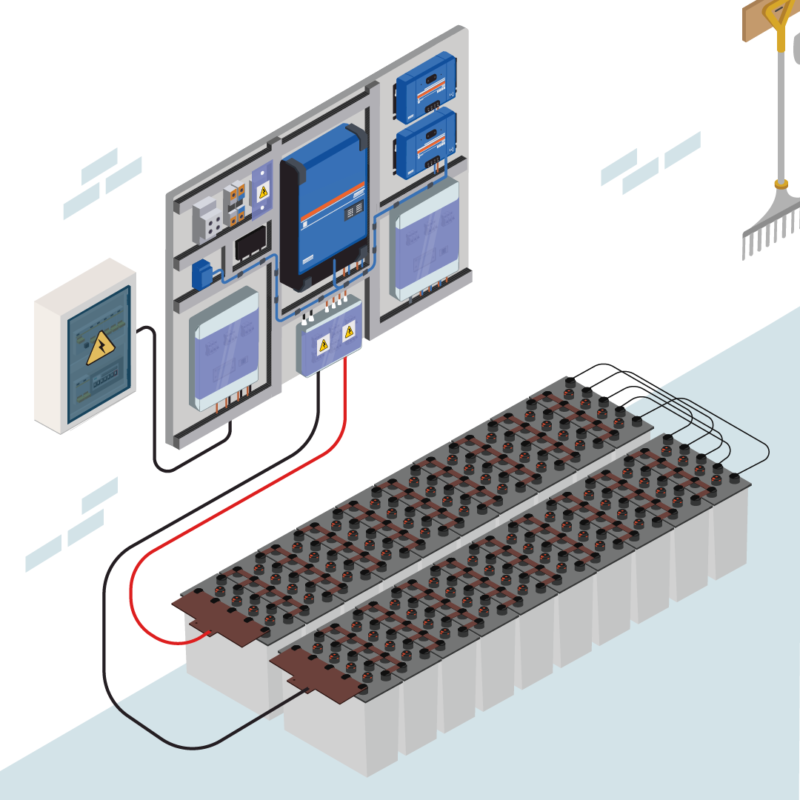
The Victron off-grid solar kit split-phase is a complete power plant on a board, built for off-grid homes that run 240 V appliances. First, two MultiPlus-II 48/5000/70-95 120 V inverter-chargers, paired on the VE.Bus, produce a true 120/240 V split-phase grid at 8,000 W continuous and 18 kW peak. Then, a SmartSolar MPPT 250/100 brings in up to 5,800 W of solar on a 250 V string. Moreover, a Cerbo GX with a touch screen and a SmartShunt watches the battery. That matters on an Edison nickel-iron bank, which has no BMS of its own. Finally, every breaker, fuse and surge protector is sized and wired in our workshop. Both inverters are paired, programmed and tested together before they ship. In short, you connect the panels, the battery and the house panel, and you turn it on.
“An Edison battery has no BMS, so the inverter and the charge controller are the BMS. That is why we insist on the Victron platform for these kits: every voltage threshold is adjustable, the SmartShunt gives a true state of charge, and the Cerbo lets us check the bank from the workshop. The pre-wiring is the easy part. The programming is what keeps a nickel-iron bank healthy for twenty-five years.”
— Julien, Perma Batteries
Two MultiPlus-II in split-phase: 8,000 W continuous, 18 kW peak
The split-phase version pairs two MultiPlus-II 48/5000/70-95 on the VE.Bus, one per leg, 180° apart. First, each unit delivers 4,000 W at 120 V on its leg, and a 240 V load draws from both at once. As a result, the board supplies 8,000 W continuously and 18 kW peak, enough for a well pump, a dryer, a range or a 240 V mini-split. Then, both inverters charge the battery together, at 140 A from a 240 V generator. Moreover, each leg keeps its own 95 A transfer switch. However, the two units must be the same model and firmware. That is why we pair, configure and test them together before shipping.
| Parameter | 120/240 V split-phase kit |
|---|---|
| Inverter-chargers | 2 × MultiPlus-II 48/5000/70-95 120 V, VE.Bus split-phase |
| Continuous power at 77 / 104 / 149 °F | 8,000 / 7,400 / 6,000 W |
| Peak power | 18,000 W |
| AC output | 120/240 V · 60 Hz · 4,000 W per leg |
| Generator transfer | 95 A per leg, 240 V split-phase generator |
| Generator charge current | 140 A |
| Solar charge current | 100 A (second MPPT optional) |
| Total charge current | 240 A |
| Zero-load consumption | 30 W · 20 W AES · 6 W search |
| Inverter weight | 2 × 71 lb |
💡 What it means for you
MultiPlus-II 48/5000/70-95 120 V: inverter, charger and transfer switch
The MultiPlus-II is the heart of the Victron off-grid solar kit split-phase. First, it is a true sine-wave inverter rated 5,000 VA, with a 9,000 W peak for motor starts. Then, it is a 70 A battery charger with a four-stage adaptive algorithm and a temperature sensor. Moreover, it holds a 95 A transfer switch for the generator, with PowerAssist. When loads exceed what the generator can supply, the battery adds the difference. As a result, a 4 kW portable generator runs a house that briefly needs 8 kW. Finally, it is UL 1741 and UL 458 listed, and certified to CSA C22.2 No. 107.1 for Canada.
| Function | Rating per unit | Practical reading |
|---|---|---|
| Inverter | 5,000 VA · 4,000 W at 77 °F · 96 % efficiency | runs a 1 hp well pump or a 12,000 BTU mini-split |
| Peak | 9,000 W | motor and compressor starts |
| Charger | 70 A at 57.6 V absorption · 55.2 V float | reprogrammed for nickel-iron |
| Transfer switch | 95 A · 90 to 140 VAC · 55 to 65 Hz | accepts a poorly regulated generator |
| Auxiliary output | 48 A, live only on generator | water heater or EV charger on generator only |
| Programmable relay | 120 V / 4 A · 35 VDC / 4 A | generator auto start/stop on SOC |
| DC input | 38 to 66 V | 40-cell Edison bank window |
| Zero-load | 15 W · 10 W AES · 3 W search | small overnight drain |
SmartSolar MPPT 250/100-Tr VE.Can: 5,800 W of solar on a 250 V string
Solar charging is handled by a dedicated controller, so the PV array is sized independently of the inverters. First, the SmartSolar MPPT 250/100 accepts up to 250 V open-circuit, 245 V in operation. That allows strings of five or six 60-cell modules. Then, it delivers 100 A at 48 V, or 5,800 W of nominal PV. Moreover, its ultra-fast tracking and partial-shading algorithm hold the true maximum power point under moving clouds. Efficiency exceeds 99 % without a fan. Finally, the VE.Can port synchronizes charging across up to 25 controllers and connects to the Cerbo GX. The charge algorithm is fully programmable, including equalization and temperature compensation. An Edison bank needs both.
| Parameter | Value | Practical reading |
|---|---|---|
| Rated charge current | 100 A | 5,800 W nominal PV at 48 V |
| Max. PV open-circuit voltage | 250 V (245 V operating) | 5 to 6 modules of 60 cells in series, cold-corrected |
| Max. PV short-circuit current | 70 A (30 A per MC4 pair) | up to 3 strings in parallel with fuses |
| Max. efficiency | 99 % | no fan, no filter |
| Absorption / float / equalization | 57.6 / 55.2 / 64.8 V default, adjustable | nickel-iron profile loaded before shipping |
| Temperature compensation | -64 mV/°C at 48 V | with external sensor via Cerbo or SmartShunt |
| Communication | VE.Can · VE.Direct · Bluetooth | Cerbo GX, VictronConnect app |
| Terminals | 35 mm² / 2 AWG (Tr model) | screw terminals, no MC4 on the controller |
| Weight | 9.9 lb (4.5 kg) | wall-mounted on the board |
⚡ The Perma Batteries tip
Built for the Edison battery: 40 cells, no BMS, fully programmable charging
An Edison nickel-iron bank is the reason this board exists. First, 40 cells of 1.2 V make a 48 V bank, from 100 to 1,200 Ah, up to 55 kWh. Then, the bank has no BMS, so the inverters and the controller enforce every threshold. We program absorption at 1.60 V per cell, 64 V on the bank, with float around 1.45 V per cell. Moreover, the SmartShunt provides the state of charge that a nickel-iron cell’s flat voltage curve cannot. The Cerbo GX triggers the generator from that reading. Finally, the kit remains battery-agnostic. The same board runs a lithium rack with a BMS on the Cerbo, or a lead-acid bank, with a different charge profile.
| Bank | Cells | Nominal energy | C/5 charge current | Matches |
|---|---|---|---|---|
| 48 V · 400 Ah | 40 × 400 Ah | 19.2 kWh | 80 A | home, 1 day of autonomy |
| 48 V · 600 Ah | 40 × 600 Ah | 28.8 kWh | 120 A | home, 2 days of autonomy |
| 48 V · 800 Ah | 40 × 800 Ah | 38.4 kWh | 160 A | large home, second MPPT |
| 48 V · 1,200 Ah | 40 × 1,200 Ah | 57.6 kWh | 240 A | large home, two MPPT, big array |
⚠️ The 66 V ceiling
DC and AC protection, sized to NEC 690, 706 and 710
Every conductor on the board is protected at its source. We follow the National Electrical Code articles for PV, energy storage and stand-alone systems. First, the battery feeds a Class T fuse of 400 A with a 20,000 A interrupt rating and a DC disconnect, close to the terminals. Then, each inverter and the MPPT get their own branch fuse on a Lynx Distributor busbar. Moreover, the PV side carries a 600 V DC disconnect, string fuses and a type 2 DC surge protector. Finally, the AC side has a type 2 surge protector, a generator input breaker and output breakers in a listed enclosure. The board ships with a one-line diagram and a wiring schedule for the inspector.
| Circuit | Device | Rating | Code reference |
|---|---|---|---|
| Battery main | Class T fuse + DC disconnect | 400 A · 20 kA AIC | NEC 706.15, 240.67 |
| Inverter branch | MEGA fuse on Lynx Distributor | 200 A per MultiPlus-II | NEC 706.21 |
| MPPT output | MEGA fuse on Lynx Distributor | 125 A | NEC 690.9 |
| PV strings | DC fuse holders, 1,000 V | 15 or 20 A per string, per module rating | NEC 690.9 |
| PV disconnect | DC-rated switch | 600 V · 32 A | NEC 690.13, 690.15 |
| PV surge | Type 2 DC SPD | 600 V · 40 kA | NEC 690.7, 242 |
| Generator input | Breaker | 100 A 2-pole, 240 V | NEC 702, 710 |
| Inverter output | Breakers | 40 A + 50 A per leg | NEC 710.15 |
| AC surge | Type 2 AC SPD | 120/240 V · 40 kA | NEC 242 |
| Grounding | Ground bar, lugs, GFDI in MPPT | EGC sized per NEC 250.122 | NEC 690.41, 250 |
✅ Advantage: listed components, one schematic
Cerbo GX, GX Touch and VRM: monitoring and remote support
Every kit ships with a Cerbo GX and a GX Touch 50 screen. First, the Cerbo collects the inverters, the MPPT and the SmartShunt on one dashboard. Then, the touch screen shows energy flows, state of charge and alarms on the wall. Moreover, with any internet connection, the free VRM portal keeps the history and sends alerts. Our technicians can adjust a setting without a site visit. Finally, VictronConnect over Bluetooth gives local access to the MPPT and the shunt from a phone. No network is needed.
💡 Three levels of control
What is in the 120/240 V split-phase kit
- Victron MultiPlus-II 48/5000/70-95 120 V × 2 (paired in split-phase), UL 1741, UL 458, CSA C22.2 No. 107.1
- Victron SmartSolar MPPT 250/100-Tr VE.Can × 1, UL 1741, CSA C22.2
- Cerbo GX × 1 and GX Touch 50 × 1
- SmartShunt 500 A × 1 with battery temperature sensor
- Lynx Distributor × 1, 1,000 A busbar with MEGA fuses for each branch
- Class T battery fuse 400 A and DC disconnect, 20 kA AIC
- PV protection: 600 V DC disconnect, string fuse holders, type 2 DC surge protector
- AC protection: generator input breaker 100 A 2-pole, 240 V, output breakers 40 A + 50 A per leg, type 2 AC surge protector, listed enclosure
- VE.Bus and VE.Can cables, MK3-USB interface, external AC current sensor 100 A
- Mounting board, 4/0 AWG battery cables, ground bar, labels
- One-line diagram, wiring schedule and configuration report for the inspector
🔧 What you still do on site
Why choose a pre-wired Victron off-grid solar kit split-phase?
- Installation twice as fast as loose components, with the wiring already torqued and tested.
- Code-ready protection: fuses, disconnects and surge protection sized per NEC 690, 706 and 710.
- Listed hardware: UL 1741 inverters, CSA-certified controller, UL-listed fuses and breakers.
- Programmed for your battery before shipping, nickel-iron profile included.
- Open ecosystem: VE.Bus, VE.Can, free VRM, public documentation, long firmware support.
- Expandable: add a second MPPT, parallel more inverters, grow the battery bank.
- Repairable: every component is a standard Victron or Midnite part, replaceable individually.
- Remote support through VRM from our workshop, wherever the site is.
Victron off-grid solar kit split-phase datasheet
| Kit name | SUNCONNECT US 120/240 V split-phase · pre-wired Victron off-grid solar kit · 48 V |
| Application | off-grid, stand-alone systems only · generator as backup source |
| Configuration | SUNCONNECT US 120/240 V split-phase · 2 × MultiPlus-II 48/5000/70-95 |
| Inverter-charger | Victron MultiPlus-II 48/5000/70-95 120 V · PMP482505120 · × 2 |
| Continuous output at 77 / 104 / 149 °F | 8,000 W / 7,400 W / 6,000 W |
| Peak power | 18,000 W |
| Output voltage / frequency | 120/240 V split-phase · 60 Hz · 4,000 W per leg |
| Max. efficiency | 96 % |
| Zero-load power | 30 W (20 W AES, 6 W search) |
| AC input (generator) | 90 to 140 VAC per leg · 55 to 65 Hz · 95 A per leg, 240 V |
| Charger | 140 A total · absorption 57.6 V · float 55.2 V · storage 52.8 V (defaults, reprogrammed for nickel-iron) |
| DC input range | 38 to 66 V |
| Auxiliary AC output | 48 A per unit, active on generator only |
| Programmable relay | 120 V / 4 A AC · 4 A to 35 VDC · 1 A to 60 VDC |
| Inverter protection | output short circuit · overload · battery high / low · over temperature · 120 VAC on output · DC ripple |
| Inverter dimensions / weight | 26.6 × 13.0 × 6.5 in (676 × 330 × 164 mm) · 2 × 71 lb (2 × 32 kg) |
| Inverter listings | UL 1741 · UL 458 · CSA C22.2 No. 107.1-16 · EN-IEC 60335-1 / -2-29 |
| Solar charge controller | Victron SmartSolar MPPT 250/100-Tr VE.Can |
| Rated charge current / nominal PV | 100 A · 5,800 W at 48 V |
| Max. PV voltage | 250 V absolute · 245 V start-up and operating |
| Max. PV short-circuit current | 70 A |
| MPPT efficiency / self-consumption | 99 % · 20 mA at 48 V |
| MPPT charge voltages | absorption 57.6 V · float 55.2 V · equalization 64.8 V (defaults, adjustable) |
| MPPT protection | PV reverse polarity · output short circuit · over temperature · IP43 / IP22 |
| MPPT dimensions / weight | 8.5 × 11.6 × 4.1 in (216 × 295 × 103 mm) · 9.9 lb (4.5 kg) |
| MPPT listings | UL 1741 · CSA C22.2 · EN/IEC 62109-1 |
| Monitoring | Cerbo GX · GX Touch 50 · SmartShunt 500 A · VRM portal · VictronConnect |
| Battery main protection | Class T fuse 400 A · 20 kA AIC · DC disconnect |
| Branch protection | Lynx Distributor · MEGA fuses 200 A per inverter, 125 A for MPPT |
| PV protection | 600 V DC disconnect · string fuses 15 / 20 A · type 2 DC SPD 600 V |
| AC protection | generator input breaker 100 A 2-pole, 240 V · output breakers 40 A + 50 A per leg · type 2 AC SPD |
| Battery cables | 4/0 AWG battery cables |
| Compatible batteries | Edison nickel-iron 48 V (40 cells) · lithium 48 V with BMS · lead-acid 48 V |
| Warranty | Victron 5 years on inverter and controller · workshop assembly 2 years |
| Delivery | assembled, tested and programmed · freight truck |
Reviews
There are no reviews yet.