
SIGENERGY Sigen EVDC
October 21, 2026
48V Victron off-grid pre-wired split-phase (240V)
October 21, 2026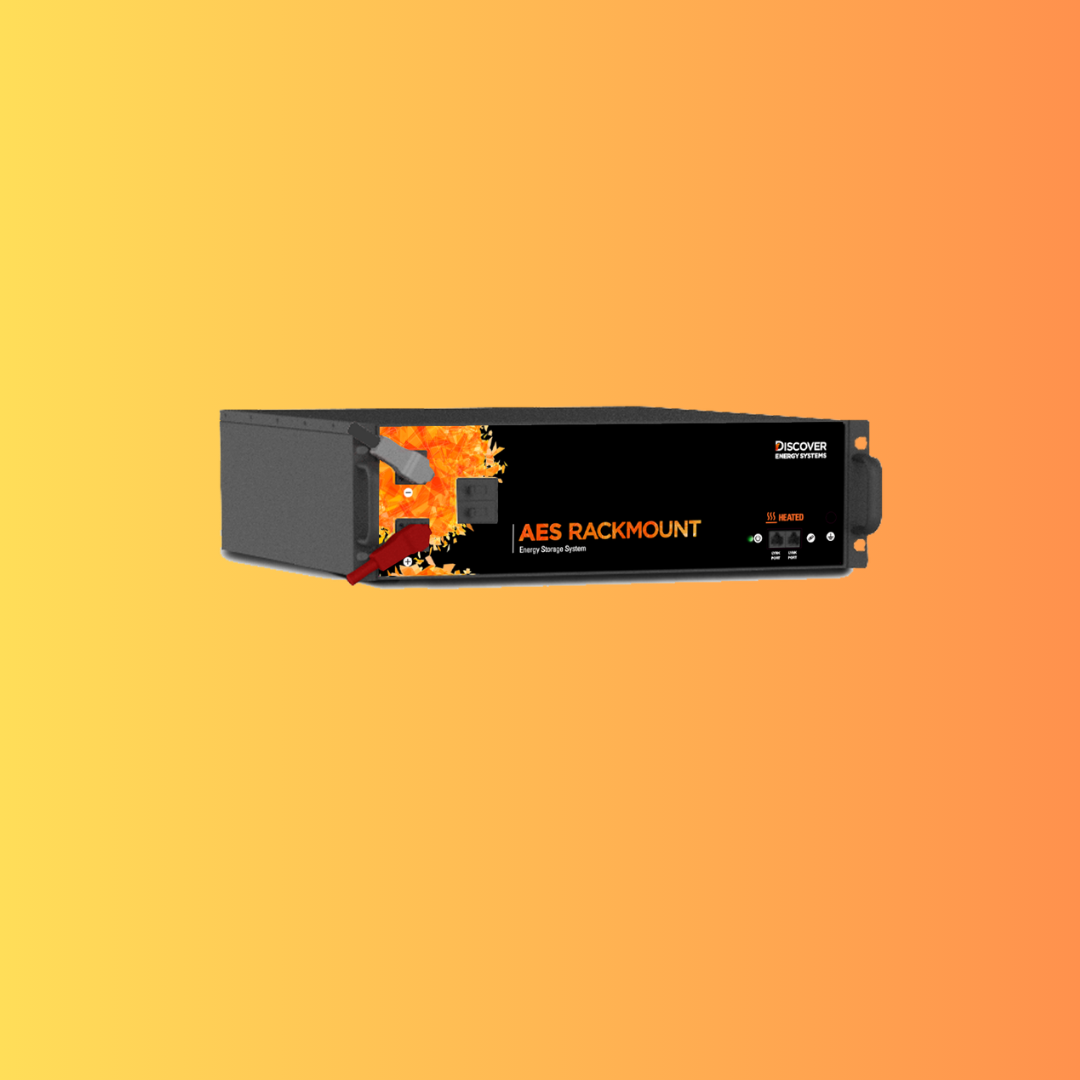
Discover AES Rackmount 48-5120
High-current LiFePO₄ rack battery
100 % usable depth of discharge
70 A continuous · 95 A for 1 hour
starts pumps and compressors
< 3 % self-discharge per month
charges through northern winters
Amphenol SurLok Plus terminals
Victron · Schneider · Sol-Ark · OutBack
6 modules per rack or combiner
10-year warranty
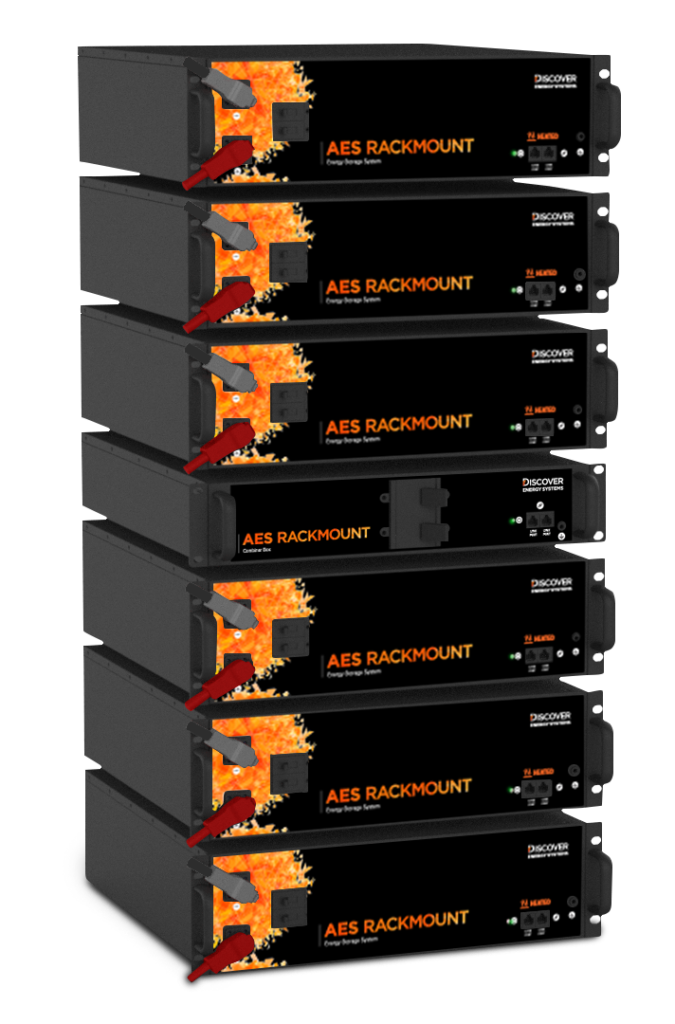
Discover AES Rackmount 48-48-5120: the 5.12 kWh LiFePO₄ rack battery with 1C charge and 2.2C peak
19-inch 3U rackmount · 51.2 V · 100 Ah · 100 % usable · 70 A continuous, 218 A peak · GEN-4 high-current BMS · self-heating (-H) · UL 1973 and UL 9540 · 10-year warranty
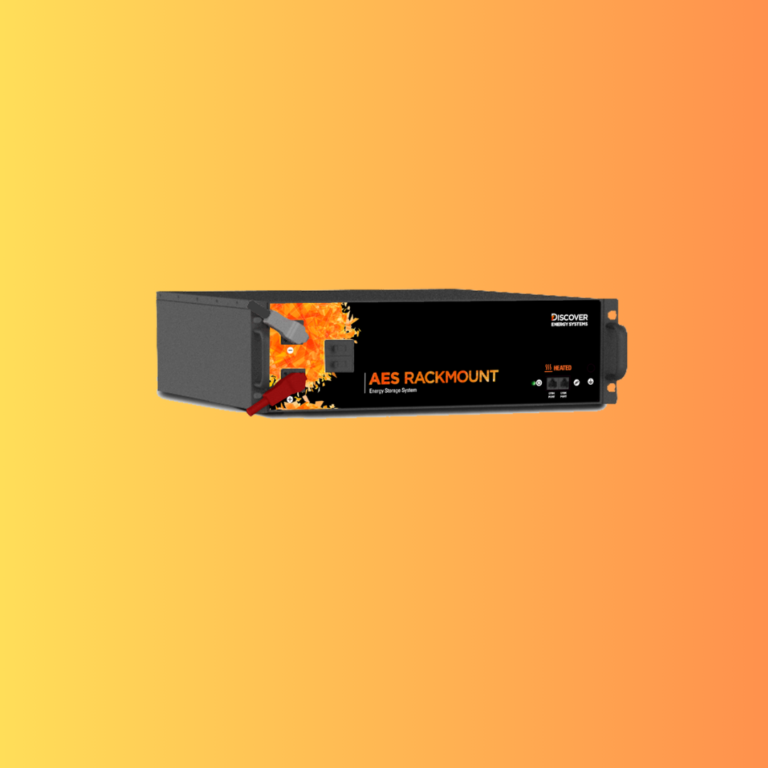
Same cells, same BMS, same rack. The -H adds an internal heater that keeps the battery chargeable from 1.4 °F (-17 °C). Choose the -H for any garage, shed or enclosure that can drop below 39 °F in winter.
The Discover AES Rackmount at a glance
| Models | AES Rackmount 48-48-5120 · 48-48-5120-H (heated) |
| Chemistry | lithium iron phosphate (LiFePO₄) · 16s1p |
| Nominal voltage / capacity | 51.2 V · 100 Ah · 5.12 kWh · 100 % usable |
| Continuous current | 70 A charge and discharge (about 3.6 kW) |
| 1-hour current | 95 A charge and discharge (about 1C) |
| Peak discharge | 218 A RMS for 3 s (about 2.2C, 11 kW) |
| Efficiency | up to 98 % round trip |
| Form factor | 19-inch 3U rackmount · 19.6 × 17.3 × 5.3 in · 97 lb |
| Scaling | up to 6 modules per combiner or Quick Stack rack · up to 184 kWh per LYNK II Gateway |
| Communication | LYNK port · closed-loop with LYNK II Gateway · CANopen, Serial CAN, J1939, RV-C |
| Temperature | charge 39 to 126 °F · discharge 1.4 to 126 °F · heater (-H) active 1.4 to 46 °F |
| Certifications | UL 1973 · UL 9540 · UL 9540A · IEC 62619 · CE · UN 38.3 |
The Discover AES Rackmount 48-48-5120 is a 5.12 kWh lithium iron phosphate battery in a standard 19-inch, 3U rack format. First, it is built around Discover’s GEN-4 high-current BMS. That allows 1C charge and discharge and a 2.2C peak. Then, it stacks up to six modules in a rack or combiner, and up to 184 kWh behind one LYNK II Gateway. Moreover, the -H version carries an internal heater for cold garages and outdoor enclosures. Finally, UL 1973 and UL 9540 listings make permitting straightforward across North America. In short, it is the rack battery for sites that need power, not just capacity.
“Most 5 kWh rack batteries are rated C/2, which means a 10 kWh bank cannot even feed a 6 kW inverter at full load. The AES is rated 1C continuous for an hour and 2.2C peak, so two modules run a 10 kW inverter and start a well pump. That changes how many modules you need: you size on energy, not on current.”
— Julien, Perma Batteries
1C charge, 2.2C peak: the GEN-4 high-current BMS
Current is the difference between the Discover AES Rackmount and a commodity rack battery. First, the BMS allows 70 A continuously in both directions, and 95 A for one hour. That is close to 1C on a 100 Ah module. Then, it surges to 218 A RMS for three seconds, about 2.2C, which covers motor starting. Moreover, the 1C charge rate holds regardless of state of charge. A generator or a large PV array fills the bank in about an hour. According to Discover, that is twice as fast as C/2-rated lithium batteries. Finally, dynamic charging lets the BMS request voltage and current in real time. Discover claims that cuts the 0 to 100 % recharge by up to 40 %.
| Rating | Per module | 2 modules | 4 modules | 6 modules |
|---|---|---|---|---|
| Energy | 5.12 kWh | 10.24 kWh | 20.48 kWh | 30.72 kWh |
| Continuous current | 70 A | 140 A | 280 A | 420 A |
| Continuous power (51.2 V) | 3.6 kW | 7.2 kW | 14.3 kW | 21.5 kW |
| 1-hour current | 95 A | 190 A | 380 A | 570 A |
| Peak, 3 s | 218 A | 436 A | 872 A | 1,308 A |
💡 What it means for you
48-48-5120-H: self-heating for cold climates
Lithium iron phosphate must not be charged below freezing. The standard module stops charging below 39 °F (4 °C) and resumes once it warms up. The -H version adds an internal heater. First, the heater activates between 1.4 and 46 °F (-17 to 8 °C) whenever charging is requested. Then, it warms the cells to the safe window and the BMS releases the charge. As a result, the battery keeps accepting solar and generator power through a northern winter. An unheated garage or a NEMA 3R enclosure is enough. However, discharge is allowed down to 1.4 °F on both versions. Backup still works in the cold.
| Temperature window | 48-48-5120 | 48-48-5120-H |
|---|---|---|
| Charge | 39 to 126 °F (4 to 52 °C) | 1.4 to 126 °F with heater (-17 to 52 °C) |
| Discharge | 1.4 to 126 °F (-17 to 52 °C) | 1.4 to 126 °F (-17 to 52 °C) |
| Heater active | none | 1.4 to 46 °F (-17 to 8 °C) |
| Storage | 14 to 86 °F (-10 to 30 °C) | 14 to 86 °F (-10 to 30 °C) |
⚡ The Perma Batteries tip
Closed-loop communication with the LYNK II Gateway
The AES speaks to the inverter through its LYNK port. First, each module broadcasts state of charge, temperature, voltage and current limits. Then, the LYNK II Gateway aggregates the string and translates it to the inverter’s protocol. CANopen, Serial CAN, J1939 and RV-C are covered. As a result, the inverter follows the BMS request instead of a fixed profile. Moreover, the gateway offers three programmable relays and remote on/off. The LYNK Access software handles firmware updates and log export. Discover lists Victron, Schneider, Sol-Ark and OutBack among the supported inverter brands. Finally, open-loop operation remains possible with the published voltage settings.
| Mode | What the inverter knows | Charge behavior | Setup |
|---|---|---|---|
| Closed loop (LYNK II) | SOC, temperature, limits, alarms | dynamic, BMS-requested voltage and current | gateway + CAT5, no manual profile |
| Open loop | voltage only | fixed bulk 55.2 V, float 53.6 V | manual settings, external SOC estimate |
✅ Advantage: one gateway, many brands
Charging the Discover AES Rackmount: voltage settings
In open loop, program the charger with Discover’s values. First, bulk and absorption both sit at 55.2 V, which is 3.45 V per cell. Then, float drops to 53.6 V. Charge termination happens at 2.5 A, or less. Finally, set the low-voltage disconnect at 48 V. The BMS cuts off at 43.2 V under load, and the cells must never rest below 3.0 V each.
| Parameter | Value | Practical reading |
|---|---|---|
| Bulk / absorption voltage | 55.2 V | 3.45 V per cell |
| Float voltage | 53.6 V | 3.35 V per cell |
| Charge termination current | 2.5 A | end absorption at 2.5 % of 100 Ah, or lower |
| Recommended low-voltage disconnect | 48 V | inverter cut-off setting |
| BMS low-voltage disconnect | 43.2 V under load | 2.7 V per cell |
| Rest voltage floor | 48 V (3.0 V per cell) | never store below this |
| Self-discharge | < 3 % per month at 77 °F | months of storage without harm |
Rack, combiner, enclosure: building a Discover AES Rackmount bank
The 3U module slides into any 19-inch rack, but Discover’s own accessories remove most of the wiring. First, the Quick Stack Rack holds up to six modules plus a combiner. The brackets interlock without tools, with an air gap for cooling. Then, the Battery Combiner joins up to six modules on a 19-inch busbar. It adds quick-connect cables, a disconnect breaker and an on/off button. Moreover, the AES Slimline Enclosure packs six modules, a 500 A busbar and the cables in a NEMA 3R cabinet. It is listed as a 30 kWh UL 9540 DC ESS, indoor or outdoor. Finally, up to four enclosures link for 120 kWh outdoors, and up to 184 kWh run behind one LYNK II Gateway.
| AES Rackmount Quick Stack Rack | up to 6 modules + combiner · tool-free interlocking brackets · air gap for heat dissipation |
| AES Rackmount Battery Combiner | 19-inch · up to 6 modules · quick-connect cables · disconnect breaker · on/off button |
| AES Slimline Enclosure | NEMA 3R indoor / outdoor · 6 modules, 30 kWh · 500 A busbar · integrated cables · UL 9540 DC ESS |
| LYNK II Gateway | closed-loop charger configuration · CANopen, Serial CAN, J1939, RV-C · 3 programmable relays |
| Terminals | Amphenol SurLok Plus, tool-free high-current connectors |
Which Discover AES Rackmount configuration do you need?
| Application | Modules | Energy | Continuous power | Hardware |
|---|---|---|---|---|
| Telecom cabinet, DC loads | 1 to 2 | 5 to 10 kWh | 3.6 to 7.2 kW | rack + LYNK II |
| Cabin or small off-grid home | 2 to 3 | 10 to 15 kWh | 7.2 to 10.8 kW | Quick Stack Rack + combiner |
| Whole-home backup | 4 to 6 | 20 to 31 kWh | 14 to 21 kW | Slimline Enclosure |
| Off-grid home, 2-day autonomy | 6 to 12 | 31 to 61 kWh | 21 to 43 kW | 2 enclosures, 1 LYNK II |
| Microgrid, light commercial | up to 36 | up to 184 kWh | up to 129 kW | 4 enclosures per gateway |
Count the kilowatt-hours first, then confirm the current with the 70 A rule. Because every module adds both energy and current, the AES bank rarely needs oversizing to meet an inverter’s surge.
Discover AES Rackmount datasheet
| Models | AES Rackmount 48-48-5120 · 48-48-5120-H (heated) |
| Industry reference | 19-inch 3U rackmount |
| Chemistry / configuration | LiFePO₄ · 16s1p |
| Nominal voltage | 51.2 V |
| Nominal energy | 5.12 kWh |
| Rated capacity (1 h) | 100 Ah · 5.12 kWh |
| Usable depth of discharge | 100 % |
| Charge bulk / absorption voltage | 55.2 V |
| Charge float voltage | 53.6 V |
| Charge termination current | 2.5 A (or less) |
| Recommended low-voltage disconnect | 48 V |
| BMS low-voltage disconnect | 43.2 V under load (2.5 V per cell) |
| Max. continuous charge / discharge current | 70 A |
| Max. charge / discharge current (1 h) | 95 A |
| Peak discharge current (3 s) | 218 A RMS |
| Round-trip efficiency | up to 98 % |
| Self-discharge | < 3 % per month at 77 °F (25 °C) |
| Charge temperature | 39.2 to 125.6 °F · 4 to 52 °C |
| Discharge temperature | 1.4 to 125.6 °F · -17 to 52 °C |
| Internal heater operating range (-H) | 1.4 to 46.4 °F · -17 to 8 °C |
| Storage temperature | 14 to 86 °F · -10 to 30 °C |
| Dimensions (L × W × H) | 19.6 × 17.3 × 5.3 in · 497 × 439 × 134 mm · 19 in with handles |
| Weight | 97 lb · 44 kg |
| Terminal | Amphenol SurLok Plus |
| Case material | galvanized steel sheet |
| IP rating | IP20 (enclosure or rack required outdoors) |
| Communication | LYNK port · LYNK II Gateway: CANopen, Serial CAN, J1939, RV-C, others |
| Parallel capacity | up to 6 per combiner / rack · up to 184 kWh per LYNK II Gateway |
| Warranty | 10-year warranty and energy performance guarantee |
| Certifications | UL 1973 · UL 9540 · UL 9540A · IEC 62619 · CE |
| Shipping classification | UN 38.3 · UN 3480 · Class 9 lithium batteries · freight truck |
| Manufacturer | Discover Energy Systems · Richmond, BC, Canada |
| Datasheet revision | 808-0040 REV B |
FAQ — Discover AES Rackmount
What is the Discover AES Rackmount 48-48-5120?
What is the difference between 48-48-5120 and 48-48-5120-H?
How much power can one module deliver?
Which inverters are compatible?
Can the Discover AES Rackmount be installed outdoors?
How many modules can I parallel?
What warranty does Discover offer?
Which certifications does it carry?
Powered By EmbedPress
Powered By EmbedPress
| Power | 3000VA, 35A,, 5000VA, 70A |
|---|
Reviews
There are no reviews yet.